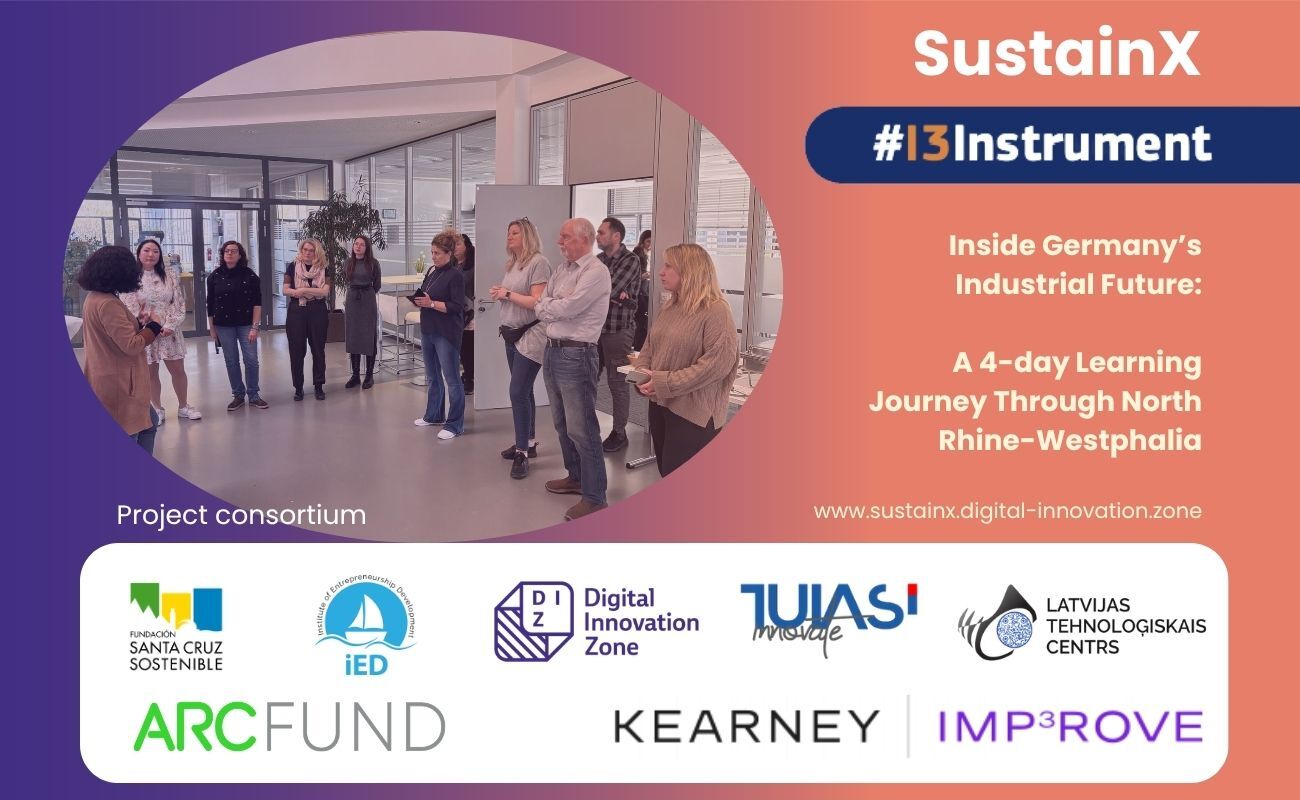
Düsseldorf: What does the future of European industry actually look like in practice? For the SustainX consortium, the answer was not found in theory, but on factory floors, in startup hubs, and inside one of Germany’s most advanced industrial laboratories.
Over the course of the visit to North Rhine-Westphalia (NRW), the focus quickly shifted from presentations to real-world experience. In Cologne, we explored STARTPLATZ, a dynamic startup hub where entrepreneurs, corporates, and researchers collaborate closely. The atmosphere was fast-paced and hands-on, with startups demonstrating how AI-driven tools, digital platforms, and sustainability solutions are already being integrated into business models.
The experience deepened in Lemgo at the Innovation Campus and SmartFactoryOWL, where we stepped directly into a functioning Industry 4.0 environment. Walking through the facility felt less like a traditional factory visit and more like entering a live experiment. Machines, sensors, and software systems interacted in real time, illustrating how modern production is becoming increasingly interconnected and data-driven. Rather than static demonstrations, the lab showcased working use cases. We observed how predictive maintenance can prevent machine failures, how digital twins simulate entire production systems, and how data flows seamlessly between machines and platforms. The concept of Industry 4.0, often discussed abstractly, became tangible as interconnected systems adapted dynamically to changing production needs.
One of the most striking parts of the visit was the focus on small and medium-sized enterprises. Instead of presenting innovation as something reserved for large corporations, the SmartFactoryOWL environment demonstrated how SMEs can experiment, test, and gradually implement new technologies. As highlighted during the lab tour, the facility serves as a neutral testing ground where companies can explore solutions before scaling them into real operations.
Sustainability was not treated as a separate topic but as an integral part of industrial innovation. In the “Smart-E-Factory” demonstrations, we saw how energy consumption can be monitored and optimized in real time, and how renewable energy sources are integrated directly into production processes. The idea of circular value creation, where materials are reused and tracked across their lifecycle, was brought to life through practical examples, including products designed with digital passports and measurable carbon footprints.
Beyond the technology itself, the journey highlighted the importance of collaboration. Whether in startup spaces or research labs, innovation in NRW is driven by close interaction between companies, researchers, and public institutions. We were not just observers but actively engaged in discussions, exchanging perspectives on how these models could be transferred to their own regions.
By the end of the visit, one thing had become clear: the strength of NRW’s approach lies not only in advanced technologies, but in how accessible and applicable they are. The learning journey transformed abstract concepts like AI, digital twins, and green manufacturing into concrete experiences, demonstrating how the future of industry is already being built, tested, and refined in real environments.